Encapsulation & Blending Solutions Supplier Since 2003

The sour gummy moisture problem starts with the hygroscopic nature of the surface acid coating. Sour gummies sweat because the malic acid and citric acid used on the surface absorb moisture from the surrounding air, causing the coating to partially dissolve, become sticky, and lose its dry, free-flowing structure. Encapsulated acid blends — including encapsulated malic acid and encapsulated citric acid — create a moisture barrier around each acid particle, helping maintain coating stability, prevent sticking, and preserve sour flavor during storage and distribution.
For confectionery manufacturers dealing with sticky gummy candy, sour candy coating that absorbs moisture during transit, or gummies clumping after packaging, the underlying issue is often the same: unprotected hygroscopic acids remain directly exposed to environmental humidity. This guide explains why sour gummy moisture problems occur, why standard formulation adjustments are often insufficient, and how encapsulated malic acid and citric acid blends address moisture-related coating failures at the ingredient level.
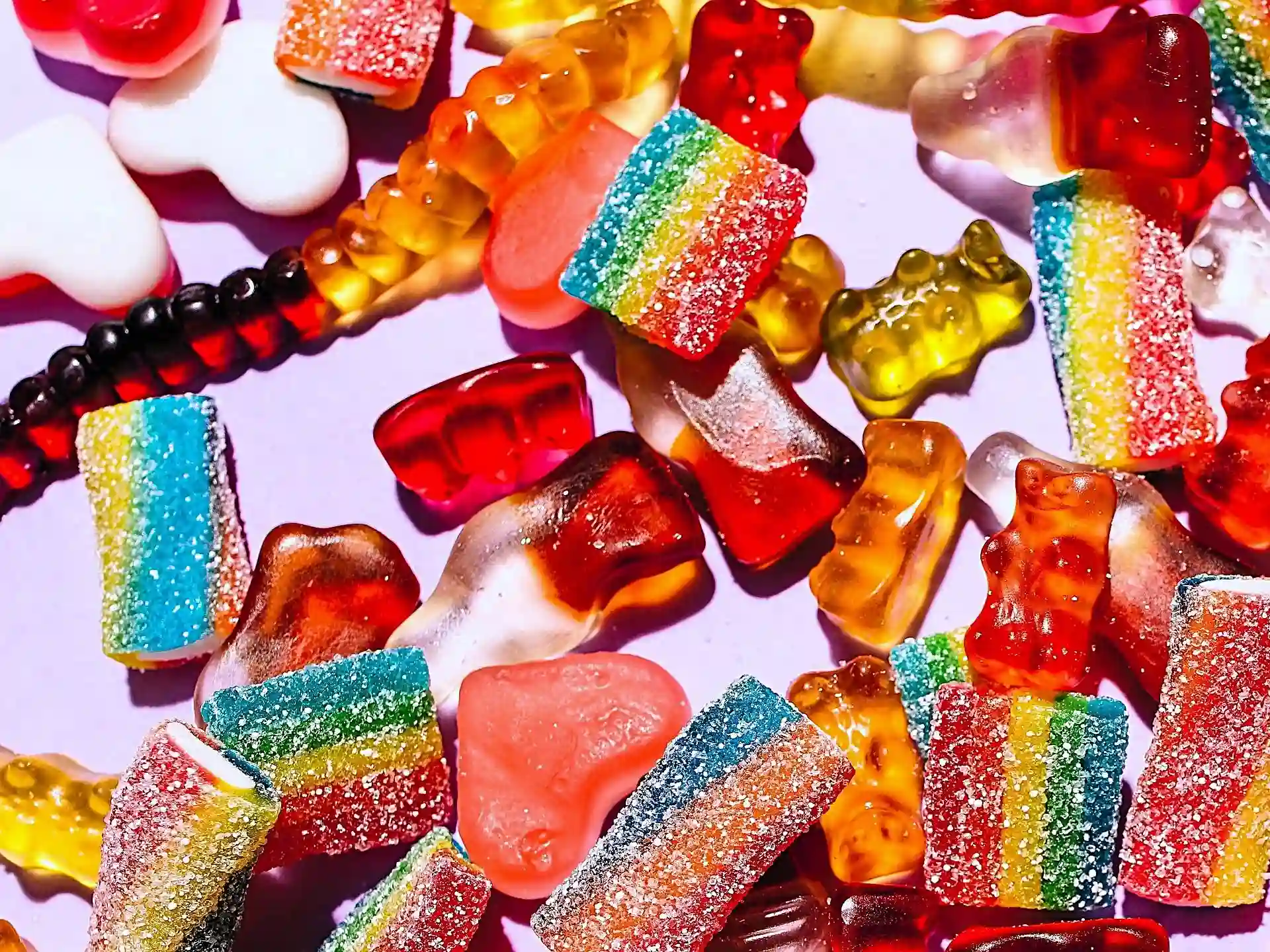
Why Sour Candy Coatings Become Sticky
The sour coating on a gummy is typically a dry blend of malic acid, citric acid, or a combination of both, mixed with sugar or dextrose and tumbled onto the gummy surface after forming. Both acids are water-soluble and hygroscopic — they have a natural affinity for atmospheric moisture. When the surface coating is exposed to moderate or high ambient humidity during warehouse storage, retail display, or distribution, the acid particles begin absorbing water from the surrounding air.
As moisture is absorbed, the coating surface becomes tacky, gummies begin to stick together, and in more severe cases the dissolved acid migrates into the gummy body — softening the texture and altering the flavor balance. The problem is compounded by temperature fluctuations during distribution. Each time the product moves between environments of different temperature and humidity, moisture exposure at the product surface changes, and cumulative uptake over a multi-week distribution chain can transform a well-made sour gummy into a sticky, clumped product that is commercially unsaleable.
Why Standard Acids and Anti-Caking Agents Are Not Enough
Manufacturers have historically managed sour candy coating moisture problems through formulation adjustments — reducing acid loading, adding anti-caking agents such as tricalcium phosphate or silicon dioxide, or modifying the sugar-to-acid ratio. These approaches can reduce the severity of sweating in some conditions, but they do not address the underlying issue: the acid itself is unprotected and will absorb moisture whenever environmental conditions allow.
Anti-caking agents improve flowability and reduce inter-particle clumping, but they do not prevent the acid from becoming hygroscopic at the gummy surface level. While packaging and storage conditions influence moisture control, addressing the hygroscopic nature of the acid coating itself is often the most effective way to improve surface stability across a range of distribution scenarios — particularly for products moving through humid markets or extended logistics chains.
How Encapsulated Malic Acid and Citric Acid Blends Work
Encapsulated malic acid and encapsulated citric acid blends place a moisture-barrier shell around each acid particle, physically separating the hygroscopic acid core from the surrounding environment. The shell — typically a hydrogenated vegetable oil matrix — is hydrophobic, presenting a non-hygroscopic outer surface while keeping the acid core isolated from ambient humidity under normal storage conditions.
In a sour gummy coating application, this means the surface coating retains its dry, free-flowing character in storage environments where standard acid coatings would begin to sweat. The individual acid particles do not absorb moisture, do not dissolve prematurely, and do not become tacky — so gummies remain separate, the coating remains intact, and the product arrives at retail in a condition consistent with how it left the factory.
The release mechanism is dissolution-triggered: when the consumer places the gummy in their mouth, saliva provides the bulk water contact that dissolves the encapsulation shell and releases the acid, delivering the full sour impact at the moment of consumption. The sensory experience is preserved — and in many cases more consistent than a standard acid-coated gummy — because the acid has been protected at full potency rather than partially consumed by moisture during storage.
Blending Encapsulated Malic Acid and Citric Acid for Sour Profile Control
Malic acid and citric acid deliver different sour taste profiles. Citric acid provides a sharp, immediate sour onset; malic acid contributes a smoother, more lingering sourness that extends the sour perception after the initial citric impact fades. Blending both creates the layered sour profile — sharp onset followed by sustained sourness — that characterizes premium sour confectionery.
When both acids are used in encapsulated form, this flavor profile is better preserved through the full shelf life. In a standard unencapsulated blend, differential moisture absorption between malic and citric acid can shift the effective ratio of the two acids in the coating over time, altering the sour profile away from the approved specification as the product ages. Encapsulated acid blends stabilize both components independently, helping ensure that the sour character at the end of the shelf life remains consistent with the product as originally formulated.
Standard Acid Coating vs. Encapsulated Acid Blend: Performance Comparison
| Parameter | Standard Malic / Citric Acid Coating | Encapsulated Acid Blend |
|---|---|---|
| Moisture barrier at particle surface | None — acid directly exposed to ambient humidity | Present — hydrophobic shell helps reduce direct moisture exposure |
| Surface sweating risk in humid conditions | High — tackiness develops under prolonged humidity exposure | Substantially reduced under standard storage conditions |
| Gummy clumping and sticking after packaging | Common in high-humidity environments | Significantly reduced across standard storage humidity range |
| Sour intensity at end of shelf life | May be reduced as acid partially dissolves or migrates | Better maintained — acid protected until consumption |
| Sour profile consistency over shelf life | May shift as differential moisture absorption alters acid ratio | More stable — both acids independently protected |
| Gummy texture stability | Risk of softening as moisture migrates into gelatin body | Better maintained — moisture migration from coating reduced |
| Anti-caking agent requirement | Higher — required to manage flowability and clumping | Encapsulation can improve flowability and reduce clumping risk |
| Suitability for export / long distribution chains | Limited in humid markets or extended transit scenarios | More suitable for demanding distribution conditions |
| Consumer experience at end of shelf life | Sticky, clumped, reduced sourness — complaint risk increases | More consistent with fresh product sensory quality |
Application Guide: Where Encapsulated Acid Blends Deliver the Most Value
Standard and premium sour gummies. The primary application for encapsulated malic and citric acid blends in confectionery is the sour gummy category — bears, worms, rings, and shaped formats where a surface acid coating is the defining sensory feature. For manufacturers supplying retail channels in humid markets or exporting through multi-week ocean freight logistics, encapsulated acid blends help make ambient shelf-life targets more commercially achievable without relying solely on high-barrier packaging or refrigerated distribution.
Sour belts and strips. Flat sour confectionery formats present a greater sweating challenge than standard gummies due to their higher surface-area-to-volume ratio — more coating surface is exposed per gram of product. Encapsulated acid blends are particularly relevant in these formats, where standard acid coatings can begin showing moisture-related quality issues within a short period of packaging in humid environments.
Sour powder dusting applications. In products where acid is applied as a fine powder dusting — sour candy shells, sour-dusted nuts, sour popcorn — encapsulated acid in a fine powder specification provides moisture protection while maintaining the even surface coverage that dusting applications require. The encapsulation shell can also reduce powder caking in dusting equipment, improving process consistency and finished product appearance.
Export confectionery with extended logistics timelines. For any sour confectionery product moving through extended logistics chains — particularly ocean freight to export markets — cumulative humidity exposure during transit creates moisture challenges that standard acid coatings may not withstand. Encapsulated acid blends provide an additional layer of protection that complements appropriate packaging selection for these demanding distribution scenarios.
Conclusion
Sour gummy sweating, sticky candy coating, and gummies sticking together after packaging are symptoms of the same underlying issue: unprotected malic acid and citric acid on the gummy surface absorb moisture from the environment, and anti-caking agents or packaging adjustments alone do not fully compensate for this hygroscopic behavior across all distribution conditions. Encapsulated acid blends address the problem at the ingredient level — reducing moisture uptake, preserving coating integrity, and maintaining sour flavor consistency through the full shelf life and distribution chain.
Niranbio supplies food-grade encapsulated malic acid and encapsulated citric acid in confectionery-optimized specifications, including fine powder formats for dusting applications and granular formats for tumble coating processes. Products are manufactured under ISO 22000-certified conditions with full batch documentation — Certificate of Analysis, particle size distribution data, and regulatory compliance declarations for major global markets — provided as standard.
For manufacturers evaluating encapsulated acid systems for sour confectionery applications, Niranbio provides technical specifications, application samples, and formulation guidance to support your development process. Contact our team to discuss your specific application requirements.
FAQs
Why do sour gummies sweat and become sticky?
Sour gummy sweating is caused by the hygroscopic nature of the surface acid coating. Malic acid and citric acid readily absorb moisture from the surrounding air, causing the coating to partially dissolve and become tacky. This is particularly common in humid storage environments, during temperature fluctuations in distribution, and in export scenarios where products are exposed to variable humidity conditions over extended transit periods.
Why does sour candy coating absorb moisture?
Malic acid and citric acid — the two most commonly used acidulants in sour candy coatings — are water-soluble compounds with a natural affinity for atmospheric moisture. In their standard crystalline form, every particle surface is an active moisture absorption site. When ambient humidity rises above moderate levels, the acids begin absorbing water, the coating surface becomes tacky, and the product starts to sweat. Encapsulated acid blends address this by placing a hydrophobic shell around each particle, reducing direct moisture contact under normal storage conditions.
Why do gummies stick together after packaging?
Gummies sticking together after packaging is typically a sign that the surface acid coating has absorbed enough moisture to become tacky, causing individual pieces to adhere to each other. Contributing factors include high ambient humidity during storage or distribution, insufficient packaging barrier properties, and the use of unprotected hygroscopic acids in the surface coating. Switching to encapsulated acid blends reduces moisture uptake at the particle level and can significantly improve product separation through the shelf life.
What is the difference between malic acid and citric acid in sour gummy coatings?
Citric acid delivers a sharp, immediate sour onset; malic acid provides a smoother, more lingering sourness. Many premium sour gummy formulations use a blend of both to create a layered sour profile — sharp initial impact followed by sustained sourness. When both are used in encapsulated form, this flavor profile is better preserved through the full shelf life, as encapsulation prevents the differential moisture absorption that can shift the effective acid ratio in standard unencapsulated blends over time.
How can manufacturers prevent sour gummies from sticking together?
The most effective approach combines ingredient-level and packaging-level moisture management. At the ingredient level, replacing standard malic acid and citric acid coatings with encapsulated equivalents reduces the hygroscopic surface area available to absorb moisture. At the packaging level, selecting an appropriate moisture barrier film for the target market’s humidity conditions provides system-level protection. Anti-caking agents can provide additional flowability support but are most effective when used alongside encapsulated acids rather than as a standalone solution.
Is encapsulated malic acid and citric acid approved for confectionery applications?
Malic acid has a well-established regulatory status as a food additive acidulant in major global markets, including the EU (E296), US (FDA GRAS), and China (GB 2760). Encapsulation is a physical processing technique that does not alter the regulatory status of the active ingredient. Manufacturers should verify specific usage level limits and labeling requirements for their target markets and product categories. Niranbio provides full regulatory documentation to support market-specific compliance requirements.