Encapsulation & Blending Solutions Since 2003

Controlled-release flavor in chewy candy means holding aroma inside the piece until a defined trigger, then releasing it in stages as the candy is chewed. In a taffy, fruit chew, or caramel-type mass, that trigger is mechanical: crisp encapsulated granules stay intact in the mass and break under chewing shear, adding a later burst to the flavor that was there from the first bite. The opening taste and the late-chew taste can be designed separately, rather than leaving one unprotected dose of flavor to do both jobs.
Why Chews Are a Special Case for Flavor Timing
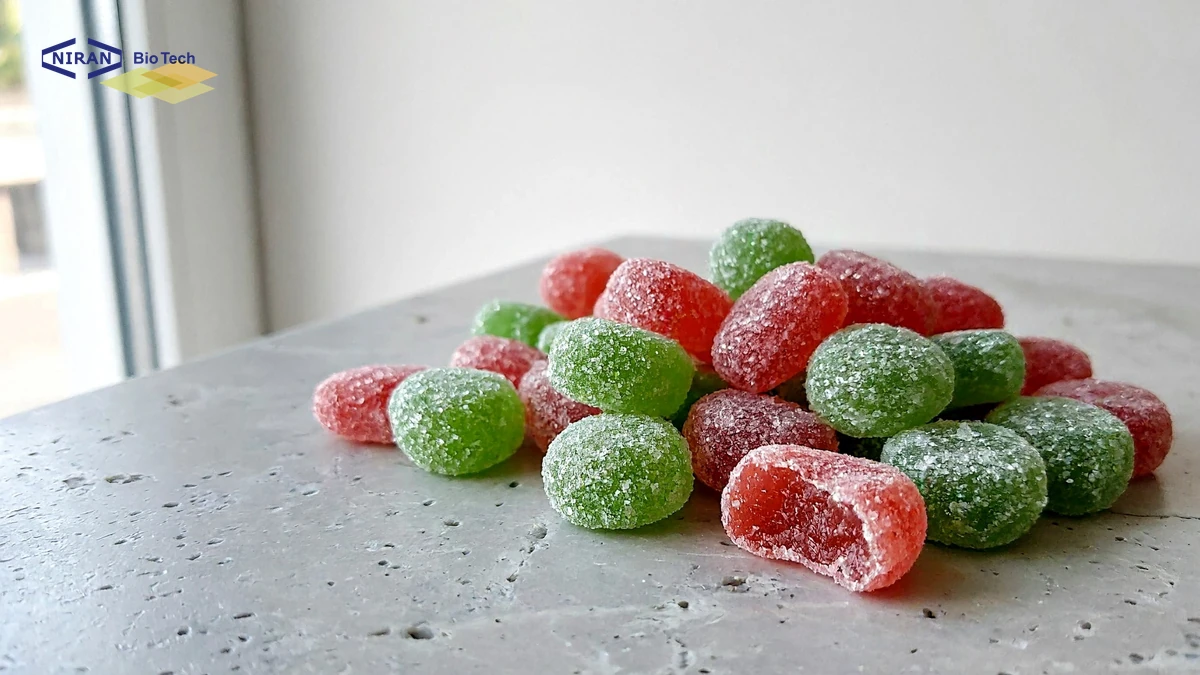
A chew is a plastic, cooked-sugar mass that still holds residual water, often with fat, and sometimes milk solids, gelatin, starch, or fruit puree. It is not a deposited gummy gel and not a low-moisture hard-candy glass. A hard candy dissolves or is crunched; a chew is worked between the teeth for a longer time, so flavor timing becomes a design question.
Unprotected liquid or powder flavor disperses easily in a still-plastic mass and is usually added after the cook, once the mass has cooled. That gives a clean opening impression, but the weak points show up afterward. Volatile top notes can flash off if the flavor goes in while the mass is still hot. Residual moisture and fat can move or mute aroma during storage. During a long chew, unprotected flavor is often front-loaded, and once that first impression fades, there is no later reservoir left in the piece. For the moisture and texture context of chews, see the article on sour chewy candy; the point here is flavor, not acid.
How Chewing Shear Releases Controlled-Release Flavor
Encapsulated Flavor from Niran Bio Tech is an extrusion-based system. Volatile aroma compounds are held in a food-grade matrix as stable granules, typically 1-2 mm (about 10-18 mesh), with a water activity below 0.5. Walls are food-grade lipids, carbohydrates, or composite systems, and can be customized. Lipids correspond to oil-type (hydrophobic) coatings and carbohydrates to water-soluble (hydrophilic) systems; co-crystallization, used for some confectionery acids, is a process, not a wall material and not the process documented for this flavor product.
The documented triggers are hydration, elevated temperature, and mechanical force. In a chew, the trigger that belongs at the center is mechanical. The granules are crisp, so they can survive in the mass as discrete particles. When the piece is chewed, they fracture and release aroma at that moment rather than all at the start. The general behavior of all three triggers is covered in encapsulated vs regular flavor. For a chew, the burst is designed around chewing shear, not around a set time on the clock.
Granules at the standard 1-2 mm size can be visible in the finished piece. A finer custom size changes both the appearance and the release feel, so both should be confirmed in a line trial.
Staged Controlled-Release Flavor in the Chew
The most useful chew design is usually staged, not either-or. A portion of regular flavor, added to the cooled mass, carries the opening taste. Encapsulated granules, mixed in late, carry later bursts of the same profile or a complementary one, such as a fruit opening followed by a later dairy or sour-fruit accent.
| Flavor placement in the chew | What happens during processing and storage | What is perceived during chewing |
|---|---|---|
| Regular flavor in the mass | Disperses easily; top notes at risk if added hot; can shift or mute with moisture and fat during storage | Strong opening, then fades |
| Encapsulated flavor (mechanical release) in the mass | Granules stay intact if the trigger is matched and handling is gentle | Quiet start, then a burst as granules break |
| Staged combination of both | Regular flavor handles the opening; granules act as a later reservoir | Clear opening plus later bursts across a longer chew |
Release-profile diagrams for encapsulated grades are illustrative. Actual release depends on the encapsulation system, ingredient properties, formulation, and processing conditions, so the staged profile has to be confirmed by sensory trial rather than assumed.
Matching the Trigger to the Chew Process
Trigger matching decides whether the granules are still intact when chewing begins. A hydration-triggered grade, designed for instant drinks, can begin releasing if it meets the residual moisture of a warm or wet chew. A heat-triggered grade can release early if the mass is still hot enough to activate it. For a chewing burst, use a mechanical-release grade and add it late, once the mass is cool enough and gentle enough that the granules can be mixed in without being crushed or prematurely activated. Confirm the processing window for the grade being tested; no melt range is stated for encapsulated flavor, and the 135-165°F / 57-74°C range used for some heat-triggered encapsulated acids does not apply here.
Pulling, extrusion, cutting, and later warm packing can also fracture granules early or activate the wrong trigger. Those steps should be checked on the line, then by sensory evaluation of finished pieces.
Flavor Load and What Encapsulation Does Not Replace
Encapsulated grades include wall material, so they do not carry the same aroma content per kilogram as a concentrated regular flavor. A one-for-one swap by weight is not a valid starting point; flavor load has to be adjusted and confirmed by sensory trial on both fresh and stored pieces. Encapsulation also does not replace a well-chosen flavor profile, late-addition discipline for any regular flavor used in the mass, or packaging and storage control. The stated shelf life of the granules is up to 4 years under recommended storage conditions; that figure applies to the ingredient itself, not to the finished chew.
Niran Bio Tech supplies encapsulated flavor in customizable profiles and grades, including fruit, dairy, nut, and savory systems, with adjustable particle size, coating systems, and release characteristics. Line trials on fresh and stored chews remain the most reliable check of opening flavor, granule integrity, and the late-chew burst.
FAQs
Does controlled-release flavor replace regular flavor in a chew?
Usually not. Regular flavor in the cooled mass gives a clean opening taste, while encapsulated granules supply later bursts. The staged combination covers the whole chew rather than only the start or only the end.
When should encapsulated flavor be added to a taffy or fruit chew?
Late, once the mass is cool enough and gentle enough that mechanical-release granules can be mixed in without being crushed or prematurely activated. Pulling, extrusion, cutting, and later warm packing should also be checked so those steps do not break the granules early.
Can a hydration-triggered encapsulated flavor be mixed into a residual-moisture chew?
It is a poor fit if the grade is designed to release on contact with water, as in instant drinks. Residual moisture in a warm or wet chew can start that release before the piece is eaten. For a chewing burst, match a mechanical-release grade to the process and confirm it on the line.
Will the 1-2 mm granules be visible in the finished chew?
They can be. The standard particle size is about 1-2 mm (10-18 mesh), and size is customizable, so a visible burst granule and a finer grade are different choices. Confirm appearance and release together in a line trial.