Encapsulation & Blending Solutions Supplier Since 2003

KEY TAKEAWAYS · 30-SECOND DECISION CARD
- Why encapsulate vitamin C? Ascorbic acid breaks down in the presence of moisture, oxygen, heat, light, and trace metals. A coating acts as a physical barrier during processing and storage.
- For cold-water effervescents: start with a hydrophilic wall — OSA-modified starch or HPMC when fast release and low residue matter most.
- Compression: 15–25 kN is a workable screening range. The right force depends on tablet size, tooling, and formulation.
- Keep the process dry: effervescent production typically runs at 25–30% RH or below, because moisture sets off the acid-base reaction early.
- Overage: a better coating may allow a lower overage — but the final figure comes from stability data, not a fixed percentage.
Why Encapsulate Vitamin C in Effervescent Tablets?
An effervescent tablet pairs an organic acid — usually citric — with sodium bicarbonate. The two must sit unchanged together through manufacturing and storage, then react the moment the tablet hits water.
Moisture is the standing threat to that balance. Let even a little in and the reaction starts ahead of schedule, releasing carbon dioxide — and inside a sealed tube, gas means pressure.
Vitamin C adds a second concern: ascorbic acid oxidizes readily, and moisture, oxygen, heat, light, and trace metal ions all speed the process.
Encapsulation wraps the vitamin C in a physical barrier — protected through processing and storage, released quickly on dissolution.
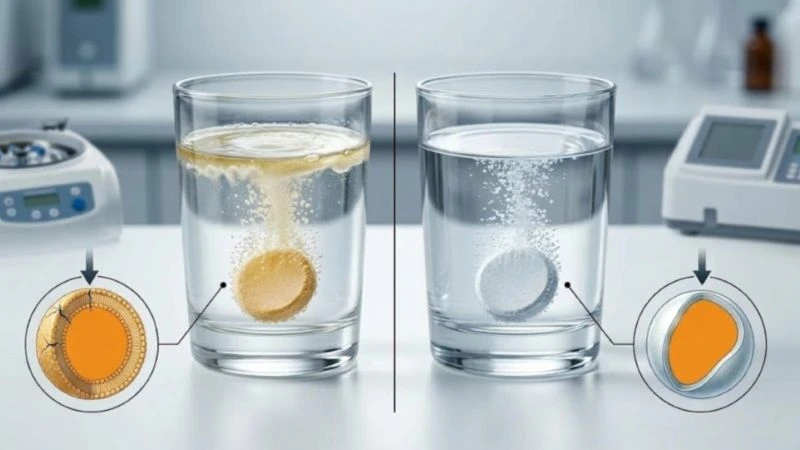
Choosing the Wall Material
Match the wall to how the product is actually used. A cold-water effervescent lives or dies on fast hydration and clean dissolution; heat resistance rarely enters the picture.
| Wall system | Main characteristic | Typical fit |
|---|---|---|
| OSA-modified starch | Water-dispersible, rapid release | Cold-water effervescent tablets |
| HPMC | Flexible hydrophilic film | Effervescents needing more coating flexibility |
| Lipid wall | Strong moisture barrier, heat resistance | Heat-processed products such as gummies |
For most cold-water effervescents, OSA-starch is the practical default: it disperses fast and leaves little visible residue. HPMC is the better choice when the coating needs more flexibility or mechanical resistance.
Lipid walls aren’t a mistake — they’re built for a different job. The same hydrophobicity that carries an active through gummy manufacturing can slow dissolution or leave a film on the surface of a cold-water drink.
One spec note: assay alone tells you little. Compare grades on wall chemistry, active loading, particle size, moisture, and release behavior.
Can Encapsulated Vitamin C Withstand Tablet Compression?
Yes — provided you treat coating and compression as one system rather than two separate decisions.
During compression, coated particles take pressure, impact, and shear. Too much force can crack the coating. Over-compaction does quieter damage, closing up the tablet’s pores so water penetrates more slowly.
Published effervescent studies cluster around 20 kN, though formulations run higher and lower. A 15–25 kN screening range is a reasonable start — then adjust for tablet geometry and tooling.
The aim is the lowest force that still delivers adequate hardness. Beyond that point, extra force buys nothing but risk to the coating and the dissolution profile.
Keep the dissolution target in view throughout. A faster number means little if the tablet turns fragile or unstable.
Encapsulation Doesn’t Replace the Dry Room
A coated vitamin C still needs a dry room. Effervescent suites typically run at 25–30% RH or below; above that, moisture sets off the acid-base reaction while the product is still on the shelf, and accelerates vitamin C degradation at the same time.
Encapsulation protects the active. It does nothing for the acid-base pair — that’s the environment’s job. A stable product still requires control of room humidity, raw-material moisture, exposure time, and package integrity.
Vitamin C Loss and Tube Bulging Are Different Problems
| Problem | Likely causes | First checks |
|---|---|---|
| Vitamin C assay loss | Oxidation, moisture, heat, light, trace metals | Assay, moisture, oxygen exposure, raw-material quality |
| Tube bulging | Moisture ingress, premature acid-base reaction | RH, blend moisture, acid/base system, package closure |
| Oily ring or haze | Hydrophobic wall, incompatible excipients | Wall chemistry, dissolution test |
| Slow dissolution | Over-compression, dense coating, lubricant, low porosity | Compression force, coating, lubricant level, tablet structure |
A bulging tube is rarely solved by switching vitamin C grades. Work through moisture, acid-base balance, coating integrity, and package closure first.
If the tube holds its shape but the assay keeps falling, shift attention to oxidation: oxygen exposure, raw-material quality, and coating performance.
Can Encapsulation Reduce Vitamin C Overage?
It can — when the coating genuinely reduces loss. Overage exists to compensate for the vitamin C lost during processing and storage; reduce the loss and the required overage comes down with it.
But the final level has to come from stability data, not a house rule like 10% or 20%. The payback shows up across the system: lower overage, fewer failed stability batches, more predictable shelf life.
FAQs
Why does encapsulated vitamin C sometimes leave an oily ring?
Usually the wall is too hydrophobic for cold water. Lipid-coated vitamin C earns its place in heat-processed products; in an effervescent, OSA-starch or HPMC dissolves cleaner.
Can encapsulated vitamin C prevent tube bulging?
No. It protects the vitamin C, not the acid-base pair — tube pressure comes from moisture setting off the reaction. Check humidity, raw-material moisture, and package closure before blaming the grade.
Which wall should I choose?
For cold-water effervescent tablets, start with OSA-starch when rapid release and clean dissolution matter most. Consider HPMC when coating flexibility matters more. Lipid systems fit products where heat resistance and moisture protection dominate.
Developing an effervescent vitamin C product?
Send your vitamin C dosage, tablet size, compression window, dissolution target, and packaging format to the Niran Bio Tech application lab — they can match wall chemistry, active loading, and particle spec to your process.