Encapsulation & Blending Solutions Since 2003

A clear, glossy piece of sugar free hard candy is a physical structure first and a flavor delivery system second. The sweetener system decides whether the cooked mass sets into a stable glass or drifts toward haze, stickiness, or grit in storage. This article compares the main bulk options by how they behave in the cooker, in the mold, and on the shelf, so formulators can narrow the choice before running trials.
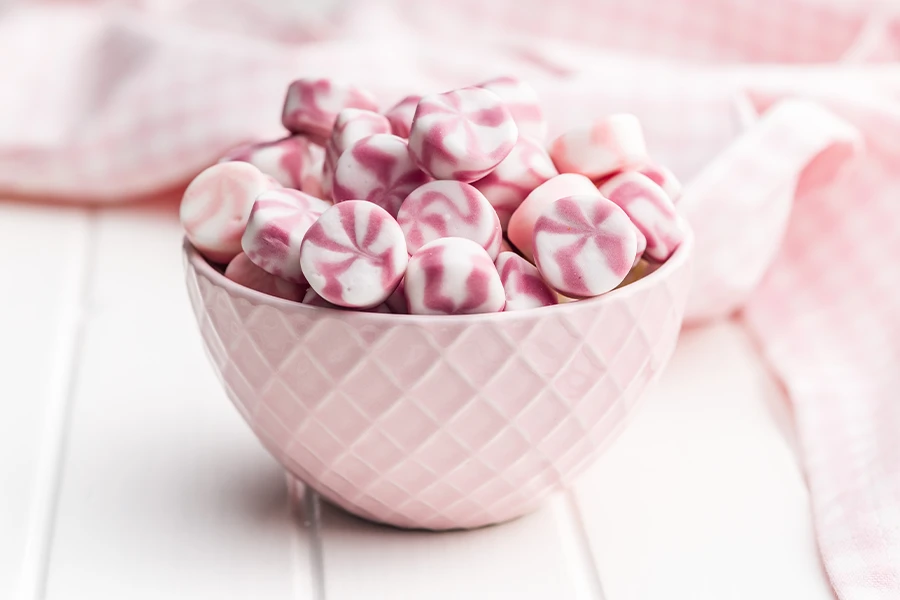
Why a Clear Hard Candy Is a Glass, Not Just a Sweet Taste
Sucrose-based hard candy is an amorphous solid: a supercooled, highly viscous mass in which the molecules are locked in a disordered state instead of an ordered crystal lattice. That glassy state gives the piece its transparency, snap, and gloss. It is also thermodynamically unstable. Given enough mobility, molecules tend to organize into crystals, which scatter light and turn the surface cloudy.
The glass stays intact when residual moisture stays low and the bulk ingredient resists crystallizing. Water acts as a plasticizer: moisture picked up after depositing lowers the glass transition temperature and lets molecules move. Judge a sweetener system for sugar-free hard candy on three points: how readily it forms a glass, how much water it attracts later, and how strongly it crystallizes out of the amorphous phase.
Why Sugar-Free Hard Candy Turns Cloudy or Sticky
Most field failures trace back to one of three mechanisms.
- Recrystallization. Erythritol has limited solubility and crystallizes readily. Used as the main bulk at high inclusion, it can grow crystals inside the glass, producing opacity or a gritty bite. Erythritol is also about 70% as sweet as sucrose, so a high-intensity partner is usually needed.
- Cooling effect. Erythritol dissolves endothermically, so it reads as cool in the mouth. In mint or menthol lines this can be welcome. In fruit, caramel, or coffee profiles it can compete with the flavor.
- Moisture uptake. Hygroscopic bulk pulls water from the air, softens the surface, and lowers the glass transition temperature. The result is tacky candy, wrapper sticking, and a dulled finish. Packaging and storage humidity matter, but the bulk sets the baseline risk.
These mechanisms interact. Surface moisture increases mobility, which can accelerate crystallization and show up as haze.
Choosing a Sweetener Blend for Sugar-Free Hard Candy
High-intensity sweeteners such as stevia and monk fruit extract add sweetness but almost no bulk, so the carrier must supply body and glass-forming behavior. For how those components balance onset and finish, see Why Do Sweetener Blends Taste More Like Sugar?.
Isomalt is a commonly used bulk sweetener in clear sugar-free hard candy because of its low hygroscopicity and good thermal stability. Maltitol is another industry option with sucrose-like body, but it is not zero calorie, and digestive tolerance can be a concern at high inclusion. Neither is part of the erythritol- or allulose-based blends below.
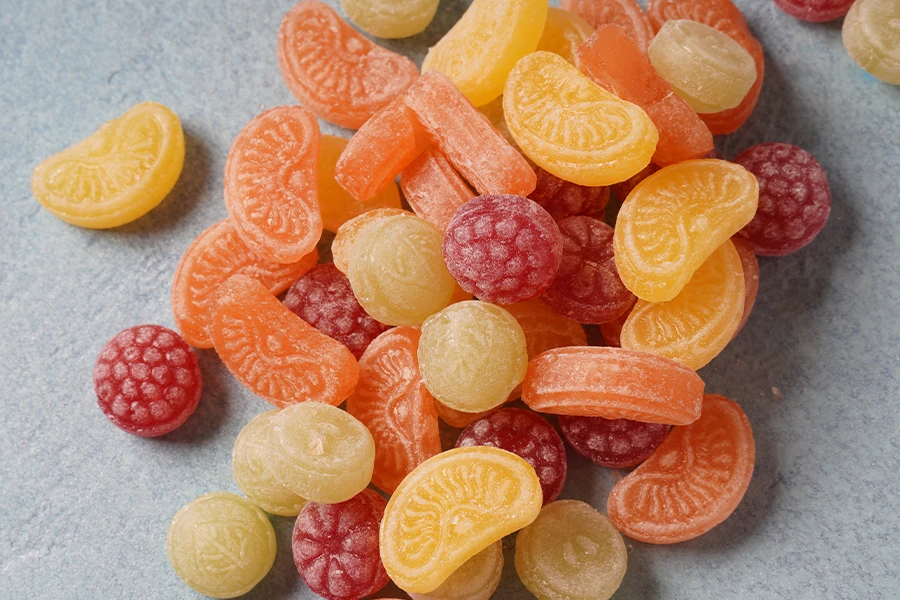
The Erythritol Stevia Blend pairs erythritol as bulk with stevia as the high-intensity sweetener. It is a white crystalline powder with customizable sweetness at 1:1, 2x, or 4x relative to sucrose, and the Reb-A / Reb-M profile can be tuned. The combination helps balance the bitterness and lingering aftertaste of stevia, and hard candies are a listed confectionery use. The Monk Fruit Erythritol Blend follows the same logic with mogrosides, also at 1x, 2x, and 4x, and reduces the aftertaste seen with high levels of monk fruit extract alone. Both rely on erythritol, so cooling and crystallization remain the main design questions, usually addressed through cooking profile, cooling rate, and flavor choice.
Allulose is the system to treat with caution. The Stevia Allulose Blend offers a more sugar-like mouthfeel and less cooling than typical erythritol systems, and it can be customized at 1x, 2x, or 4x. Allulose is hygroscopic, though, and in hard candy that often works against the goal: stickiness, surface dulling, and moisture uptake can undermine a clear, shelf-stable glass. These blends usually fit gummies, soft candy, and bakery better.
| Bulk system | Bulk role | Cooling | Moisture / stickiness risk | Best-fit formats |
|---|---|---|---|---|
| Erythritol + stevia | Crystalline bulk | Noticeable | Low uptake, crystallization risk | Hard candy, with crystallization control |
| Erythritol + monk fruit | Crystalline bulk | Noticeable | Low uptake, crystallization risk | Hard candy, with crystallization control |
| Allulose + stevia | Sugar-like bulk | Low | High: tacky and dull | Gummies, soft candy, bakery |
| Isomalt | Glass-forming bulk | Low | Low | Clear hard candy |
Sugar-free sour hard candy adds a second stress on the glass. Acid load and residual moisture leave less margin, so the same screening for hygroscopicity and recrystallization still comes first. Acid handling is a separate topic.
Niranbio Tech supplies standard and customized sweetener blends for confectionery. Glass formation depends on cooking profile, humidity, and packaging as much as on the ingredient, so line trials remain the most reliable check before scaling.
FAQs
Can erythritol alone make clear sugar free hard candy?
It is difficult. Erythritol crystallizes readily and has limited solubility, so used alone at high inclusion it tends to produce haze or grit. Blends and controlled cooking and cooling are used to manage this.
Why not use an allulose blend in hard candy?
Allulose is hygroscopic. In a glassy candy it attracts moisture, which causes stickiness and a dull surface. It suits softer formats better.
How do I reduce the cooling effect?
Cooling comes from erythritol dissolving endothermically. Matching it with mint profiles, lowering the erythritol share where the format allows, or choosing a different bulk are the common levers.
What sweetness level should I specify?
The erythritol-based blends can be customized at 1:1, 2x, or 4x relative to sucrose. Choose the level that fits your bulk loading and the room left for flavor and processing aids.